
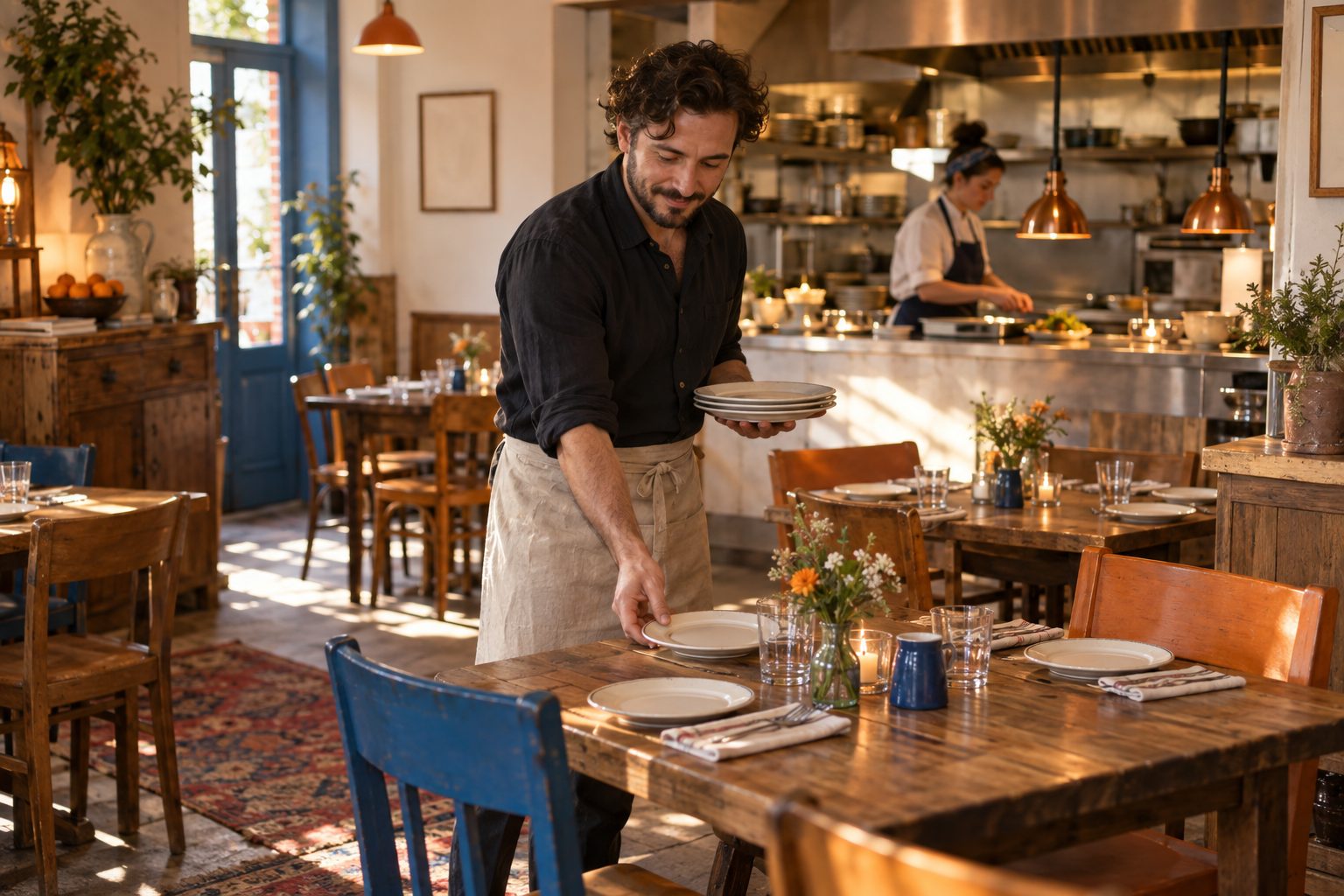
In April 2012 a Carluccio's in Manchester printed a Vespa on its menu. Not a picture of one. A scooter, listed between the dishes, from £2,400. The restaurant reviewer who spotted it took it as a joke that raised a smile, and Richard Shotton has used it ever since as the clearest example of a price anchor pushed as far as it will go. Once your eye has passed £2,400 on the way to the pasta, £16 for a plate of it has stopped looking like a question.
That is the whole subject of this post. If you want more sales out of a restaurant, the fastest money is rarely more covers. It is the same tables spending more, and most of what decides a ticket was settled by the menu and the first thirty seconds of service, before anyone in the kitchen lifted a pan. I sold for a living for more than fifteen years, and the moves below that held up in the lab are the ones the good sellers were already doing on instinct.
The first number sets the ruler
Your brain cannot judge a price on its own. It grabs the nearest number and measures from there, and it will happily use a number it knows is meaningless if that number arrived first. Tversky and Kahneman proved it in 1974 with a wheel of fortune rigged to stop on 10 or 65, followed by a question the wheel had nothing to do with: what share of African nations sit in the UN? People who spun 65 guessed 45% on average. People who spun 10 guessed 25%. A carnival number nobody believed in moved the answers twenty points.
Anchoring is also one of the few findings in this field that has been checked hard. In 2014 the Many Labs project re-ran it across 36 separate samples and it held, one of ten classic effects out of thirteen that did. You can read the longer version on the anchoring effect page.
On a menu the anchor is whatever the eye lands on first. If the dearest thing on the page is a £19 main, your £16 main is the expensive choice. Put a £58 rib-eye for two at the top of the same section and that £16 plate becomes the sensible middle, without you touching its price. The rib-eye does not have to sell. Its job is to be seen. The mistake is pulling it because nobody orders it, which makes every other price on the page dearer overnight without a single number changing.
Mark the dish you want ordered
When people are unsure, they copy what people like them did. Goldstein, Cialdini and Griskevicius tested it with hotel towels in 2008. The standard sign asked guests to reuse their towels for the environment, and 37.2% did. A sign saying that 75% of guests who had stayed in this room reused theirs took it to about 50%. The narrower the crowd, the stronger the pull.
On a menu that is a small mark next to the dishes you want ordered, with a true and specific line beside it. "Most ordered on a Friday" beats "chef's favourite", and both beat nothing. One hotel study is one hotel study, and we could not find anyone who has independently re-run this one, so treat it as a real result from one field test rather than a law. It costs you a printer cartridge to find out whether it works in your room.
What comes with the bill comes back
In 2002 Strohmetz, Rind, Fisher and Lynn had servers bring a small sweet out with the bill. One sweet lifted tips. A second sweet, handed over with eye contact and a personal word, lifted them by 21 to 23%. Nothing about the food changed. The gesture landed before the ask, and people gave back. The tip goes to your staff rather than your till, but it tells you something about the whole meal: a small unasked-for extra at the right moment is cheap, and it comes back. The study is real and published, and it has not been independently re-tested, which is true of most of this literature and worth knowing before you build a strategy on any one paper.
Slow the music down
Milliman ran slow and fast background music in a restaurant in 1986 and watched what the diners did. Under the slow music they stayed longer, ordered another round, and the bar take was 29% higher. Again, one study at one restaurant with no independent replication that we could locate. It is also the cheapest test on this page, because the playlist is already there and the knob already turns.
Trim the menu, then count
The famous jam study pulls the other way. Iyengar and Lepper set up a tasting stand in 2000 with either 6 jams or 24. The big stand drew the crowd and 3% of the people who stopped there bought a jar. The small stand converted 30%. It is the most quoted study in menu design, and in 2010 Scheibehenne, Greifeneder and Todd pooled 50 such experiments and found the average effect close to zero. More choice sometimes hurts and sometimes helps, and nobody has a reliable rule for when. So do not take the jam study's word for it. Cut one section of your menu to the dishes that actually sell, run it for a week, and read the till rather than the paper.
The dearer dress sold more
One more, because it breaks the instinct that cheaper sells. Anderson and Simester ran a field experiment with a catalogue retailer in 2003 and tested the same dress at $34 and at $39. The $39 dress sold 24% more. A price ending in 9 reads as a bargain whatever number sits in front of it. On a menu that cuts both ways. Let the dishes you want to move end in 9, and keep the prices you want read as quality round.
Try this week
Pick one section of the menu. Move the dearest dish to the top of it, in the same typeface as everything else so it reads as a real option. Count how many of the second dearest dish you sold in the seven days before and the seven days after. If it moved, do the next section. The restaurant page on this site has the anchoring play worked through for a restaurant in full, with the script for the server and the mistake to avoid, and it is free. The other 99 plays, with the scripts and the restaurant checklist, are in the $37 book.